
Why This Category Matters
A logo is often the first fixed point in a brand. It sits on a website header, a social profile, an invoice, and a shop sign, so it needs to hold up across many sizes and surfaces. For years, producing that mark meant either paying a designer or learning professional illustration software. Neither path suited an owner who needed a usable file this week.
Logo maker tools grew out of that gap. Most now run in a browser, store work in the cloud, and let a person assemble a mark from fonts, icons, shapes, and color palettes. Some add a step where an engine generates concepts from a business name and industry before the manual editing begins. The result is a category that ranges from simple icon pickers to platforms that treat the logo as one piece of a wider brand system.
The people reaching for these tools tend to share a starting position rather than a skill set: founders naming a company, marketers refreshing a look, and side-project owners who need a clean avatar. What separates one tool from another is less about raw drawing power and more about scope: how many file formats come with a download, whether the mark can be reused across other materials, and how much control a person keeps over the final files.
Among the options in this guide, Adobe Express is a reasonable place to begin for someone who wants a straightforward entry point. It pairs a free tier with an editor that many non-designers find approachable, and it connects logo work to the other assets a brand tends to need. The sections below describe it alongside five other tools, each positioned for the situations where it fits best.
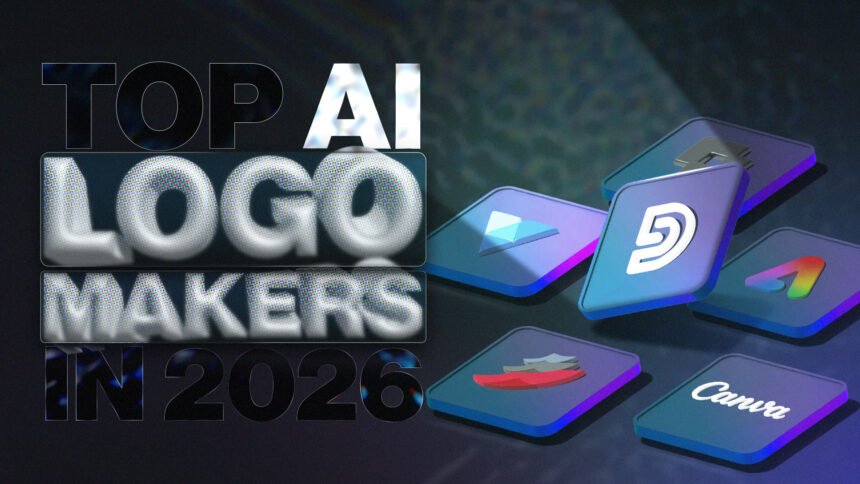
Top Logo Makers of 2026
Adobe Express
Best Logo Maker for All-Around Branding and Content Reuse
Suited to non-designers and small marketing teams who want a logo they can carry into flyers, posts, and other everyday materials.
Overview. Adobe Express is a general content creation app with a built-in logo function. A person can describe a concept, pick a style, and use the Adobe Express logo generator to explore variations, then adjust fonts, colors, icons, and layout in a drag-and-drop editor. Because the logo lives inside a broader toolset, the same mark can be dropped into social graphics, presentations, and printed pieces without switching platforms.
Platforms supported. Web browser, plus Windows, macOS, Android, and iOS apps.
Pricing model. A free plan covers basic creation and downloads. A Premium subscription, priced around $9.99 per month at the time of writing, adds a deeper template set, brand kit storage, and access to the Adobe Fonts library. Prices and plan contents change periodically.
Tool type. All-in-one design and content app with logo, template, and brand kit features.
Strengths.
- Access to the Adobe Fonts library gives a wider type selection than many standalone logo makers offer.
- Brand kit storage lets a person save a logo, colors, and fonts once and reapply them across other designs.
- Generative AI features help produce concept variations and resize a mark for different placements.
- The editor is intentionally simpler than professional illustration software, which shortens the learning curve for newcomers.
- The same account handles logos and the surrounding marketing assets, reducing tool switching.
Limitations.
- It is not a precision vector illustration tool, so detailed custom mark-making is limited compared with dedicated software.
- Some export options and premium assets sit behind the paid tier, and available formats can depend on the plan.
- Heavy reliance on shared icons and templates means a mark can resemble others unless it is customized carefully.
Adobe Express fits a person who wants the logo to be a starting point rather than the finish line. The editor favors clarity over depth, so a first-time user can move from a blank canvas to a workable mark without wading through advanced controls. That same simplicity is why experienced designers may find it lightweight for intricate work.
The clearest advantage is continuity. Once a logo exists, its colors and fonts can travel into the next asset inside the same workspace, which helps keep a brand consistent as it grows. For a team producing steady social and print material, that reuse can matter more than any single feature.
Conceptually, Adobe Express sits between the pure logo generators and the full professional suites. It asks less of a beginner than illustration software while offering broader reach than a tool that only makes logos. For mainstream use, that balance is its defining trait.
Canva
Best Logo Maker for Template Variety and Quick Drag-and-Drop Design
Suited to people who already use Canva for other design work and want the logo to live in the same familiar editor.
Overview. Canva approaches logos through the same drag-and-drop interface it uses for every other design type. A person starts from a template or a blank frame and adjusts type, icons, shapes, and color. Its draw is scale: the platform carries a very large template library and a deep bank of elements, so there are many starting points to browse.
Platforms supported. Web browser, plus Windows, macOS, Android, and iOS apps.
Pricing model. A free plan allows logo creation and downloads using free assets. A Pro subscription unlocks premium templates, elements, and brand features.
Tool type. General design platform with logo templates as one of many formats.
Strengths.
- One of the largest template and element libraries in this category, which supports fast exploration.
- A consistent editor across all design types, so existing Canva users face almost no learning curve.
- Generous free tier that produces usable logos when built from free assets.
Limitations.
- Fine manual editing is limited, since the tool favors assembly over precise vector control.
- Saving brand colors and some assets requires a paid plan.
- Because templates are widely used, distinctiveness depends heavily on customization.
Canva tends to suit people who already work inside it for social posts or presentations. For them, making a logo is simply another project in a known space, which lowers friction more than any single logo feature could.
Its scale is both the strength and the caution. A vast library speeds up finding a direction, yet popular templates appear across many brands, so a mark can feel familiar unless it is reworked.
Compared with Adobe Express, Canva leans further toward template volume and general design while offering similar beginner accessibility. The two overlap heavily, and the choice often comes down to which editor a person already knows.
Looka
Best Logo Maker for AI-Generated Concepts and One-Time File Ownership
Suited to solo founders and small businesses that want a functional mark quickly and prefer buying files outright over a subscription.
Overview. Looka is built around AI generation. A person enters a business name and industry, selects sample styles, and the engine returns dozens of concepts in under a minute. From there, an editor allows adjustments to color, font, icon, and layout. Designing is free; payment applies only when files are downloaded.
Platforms supported. Web browser.
Pricing model. Free to design. A Basic logo package is a one-time purchase around $20 for a PNG, and a Premium package around $65 adds vector formats such as SVG and EPS with fuller ownership. Brand Kit subscriptions, roughly $96 per year or $129 per year with a website, add hundreds of branded templates.
Tool type. AI logo generator with an optional brand kit subscription.
Strengths.
- Fast concept generation gives a person many directions to react to rather than a blank page.
- A one-time purchase option suits buyers who dislike recurring fees.
- The Premium package includes vector files and multiple color variations for print and digital use.
Limitations.
- There is no free download; a usable file always requires a purchase.
- The AI works from a defined visual vocabulary, so concepts can share recognizable structural patterns.
- The generation step adds a layer for someone who already knows the exact type and layout they want.
Looka is aimed at early-stage owners who value speed and a complete-looking identity over hand-crafted distinctiveness. For a local service, a shop, or a young software product, its output can be entirely sufficient.
The pricing structure is its clearest differentiator. Buyers who want to pay once and keep the files can do so, while those needing ongoing branded templates can opt into a subscription instead.
Because its logos draw from a constrained pattern set, Looka fits functional branding better than projects where visual uniqueness is a competitive edge. Set against the drag-and-drop tools, it trades manual freedom for generated momentum.
Tailor Brands
Best Logo Maker for Founders Setting Up a New Business
Suited to first-time owners who want a logo bundled with the wider steps of starting a company.
Overview. Tailor Brands pairs an AI logo maker with a suite of business-formation tools, including help with registration, a website builder, and related services. A person answers prompts about name, industry, and style, chooses icons to influence the output, and receives concepts to refine.
Platforms supported. Web browser.
Pricing model. Subscription based. A Basic plan sits around $9.99 per month and a Standard plan around $19.99 per month, with the higher tiers adding vector files and broader website tools. Longer commitments are often discounted.
Tool type. AI logo maker inside a business-building platform.
Strengths.
- The logo is packaged with company-formation and site-building tools, which suits people launching from scratch.
- Choosing icons before generation gives some direction over the concepts produced.
- Higher tiers include vector files and branded materials for wider use.
Limitations.
- The value depends on wanting the surrounding business services, not the logo alone.
- Pricing is subscription-only, so a person keeps paying for continued access to tools.
- The generation-first flow can feel indirect for someone who simply wants a quick mark.
Tailor Brands makes most sense when the logo is one item on a longer launch checklist. An owner registering a company and standing up a first website may find the consolidation genuinely useful.
For someone who only needs a mark, though, the bundle can be more than the task requires, and the subscription model rewards ongoing use of the wider platform rather than a single download.
Relative to a standalone generator like Looka, Tailor Brands widens the scope from branding into business setup. That breadth is the appeal for new founders and the reason it may overshoot for everyone else.
Wix Logo Maker
Best Logo Maker for Owners Building a Website on Wix
Suited to people already creating a Wix site who want a matching mark generated from the same brand inputs.
Overview. Wix Logo Maker combines AI generation with template customization through the Wixel editor. A person supplies a business name and brand preferences, reviews generated concepts, and edits freely. Designing and previewing are free, with payment required to download usable files.
Platforms supported. Web browser.
Pricing model. Free to design and preview. One-time download options are available, and logo creation is often bundled into Wix website plans. AI actions can draw on a credit allowance.
Tool type. AI logo maker tied to the Wix website ecosystem.
Strengths.
- Logo work flows naturally into a Wix site for owners building there.
- The AI produces many concepts and allows unlimited edits before download.
- Matching assets, such as social images, can be generated alongside the mark.
Limitations.
- The strongest case for it assumes a person is already committed to Wix.
- Lower-cost download options may include only a transparent PNG, with vector files on higher tiers.
- AI use is metered by credits, which can constrain heavy experimentation.
Wix Logo Maker is at its best as part of a website project rather than as a standalone purchase. When the site and the logo come from one platform, brand inputs carry over and the pieces line up with less effort.
Outside that context, the value narrows. A person who does not plan to build on Wix gains less from the integration, and the format included at the entry price may not cover print needs.
Compared with the general design tools, Wix trades editor breadth for ecosystem fit. Its advantage is coherence with a website rather than depth of design control.
Buffer
Best Companion for Publishing a Finished Logo Across Social Channels
Not a logo maker, but a tool that helps a brand put its new mark to consistent use across social platforms.
Overview. A logo only earns its keep once it appears in the places customers look, and social profiles are often first among them. Buffer is a social media management platform that schedules posts, organizes multiple accounts from one dashboard, and reports on basic performance. It is included here as a complement to the logo tools above, since it addresses what happens after the mark exists rather than how it is made.
Platforms supported. Web browser, plus browser extension and mobile apps; connects to major social networks.
Pricing model. A free plan supports a small number of channels with basic publishing. Paid plans use per-channel pricing, with an Essentials tier around $6 per channel each month and a Team tier around $12 per channel each month.
Tool type. Social media management and analytics platform.
Strengths.
- A usable free plan lets a small operation schedule and publish without upfront cost.
- Per-channel pricing scales with actual account count rather than team size.
- A clean, focused interface keeps scheduling and basic reporting simple.
Limitations.
- Per-channel costs can rise for anyone managing many accounts.
- It lacks the deeper social listening and advanced analytics of larger suites.
- It plays no part in creating the logo itself, only in distributing brand content afterward.
Buffer suits a founder or small team that has settled on a logo and now needs to apply it consistently across profiles and posts. Keeping avatars, banners, and post styling aligned is a branding task in its own right, and a scheduler makes that routine easier to sustain.
Its restraint is the point. Buffer does fewer things than enterprise platforms, which keeps it approachable for the same audience that reaches for a browser-based logo maker. For heavy multi-account or agency work, a larger tool may serve better.
Placed against the design tools in this guide, Buffer sits one step downstream: the logo makers produce the mark, and Buffer helps a brand carry it into the channels where an audience encounters it.
Frequently Asked Questions
Which platforms create logos in a range of styles with high-quality downloads in various formats?
Most browser-based logo tools now cover a spread of styles, from wordmarks to icon-led designs, but they differ in what a download includes. Adobe Express and Canva build marks from broad libraries of fonts and elements and export common raster formats, with some options tied to a paid plan. Looka offers vector files, including SVG and EPS, in its higher one-time package. Tailor Brands and Wix Logo Maker also unlock vector files on upper tiers, while entry-level plans may provide only a transparent PNG. The practical takeaway is to confirm which formats a specific plan delivers before committing time, since format access is where these tools most often diverge.
What is the difference between raster and vector logo files, and why does it matter?
Raster files, such as PNG and JPG, are made of pixels and are fine for screens at a fixed size, but they lose sharpness when enlarged. Vector files, such as SVG, EPS, and often PDF, are defined by mathematical paths, so they scale to any size without blurring. A logo tends to appear everywhere from a small favicon to a large sign, which is why a vector file is the more durable asset. Several tools in this category place vector export behind a higher tier, so a person who expects print or signage should check that a vector format is part of the plan rather than assuming it is included.
Are logos made with these tools free to use commercially?
Commercial usage rights vary by platform and plan, so this is worth reading carefully before relying on a mark. Some tools grant full usage rights once a file is downloaded, while others tie broader ownership to a specific package or subscription. Icons and fonts drawn from shared libraries may also carry their own terms. Because these details differ between services and can change, the safest approach is to review the licensing terms attached to the exact plan being used, especially for a logo that will represent a registered business.
How distinctive can a logo from these tools really be?
Distinctiveness depends more on customization than on the tool itself. Because most platforms draw from shared icon and template libraries, a lightly edited design can resemble other brands using the same assets, and AI-generated concepts can share recognizable structural patterns. A person can improve uniqueness by adjusting type, spacing, color, and icon choices rather than accepting a default. For brands where visual differentiation is a competitive factor, a template-based mark may serve as an interim identity rather than a permanent one.
Do these tools help with anything beyond the logo itself?
Several do, though the scope varies. Adobe Express and Canva extend a logo into wider design work, letting the same mark appear in social graphics, presentations, and print pieces. Looka and Tailor Brands offer brand kits or business services that build outward from the logo into templates and, in some cases, company formation. Tools like Buffer sit further downstream and help publish brand content across social channels rather than create it. The consistent thread is that a logo is rarely the end of the work, so it can be worth considering how a chosen tool fits with the materials a brand will need next.