

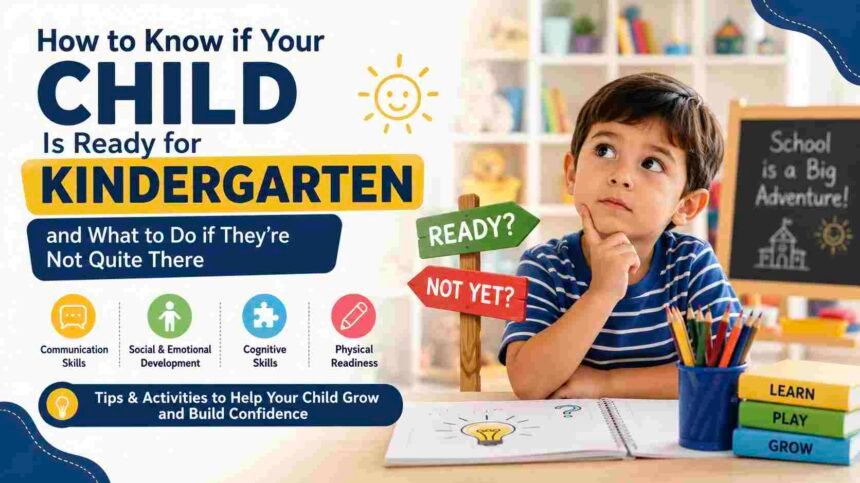
One of the questions parents of four- and five-year-olds find themselves asking most often is some version of: is my child ready? The question matters more than it might seem at first. Starting kindergarten before a child has the foundational skills they need can mean a first school experience defined by struggle rather than growth. Waiting too long when a child is genuinely ready can mean a year of under-stimulation at a critical point in their development.
What Kindergarten Readiness Actually Means
There’s a common assumption that kindergarten readiness is primarily about academic knowledge: Can my child count to twenty? Do they know their letters? Can they write their name? Those things matter, but they’re only one dimension of readiness, and often not the most important one.
The skills that most often predict a successful kindergarten transition are social and emotional: the ability to separate from a parent without extended distress, to follow a two- or three-step instruction, to sit and focus on a task for a reasonable period of time, to manage frustration without a meltdown, and to interact with peers and adults in a way that allows for participation in a group setting. A child who knows every letter of the alphabet but melts down when things don’t go their way, or who can’t sustain attention through a short activity, is going to find kindergarten significantly harder than a child whose pre-academic skills are more modest but who can handle the social and emotional demands of a classroom environment.
This doesn’t mean academic preparation doesn’t matter. It means that readiness is multidimensional, and all the dimensions deserve attention in the year before kindergarten begins.
The Social Readiness Signals Worth Watching
A few specific behaviors tend to be reliable indicators that a child is socially ready for the kindergarten classroom.
Can your child spend time with other children without constant adult mediation? Do they show some ability to work out minor conflicts, to share materials, and to take turns in a group activity? These don’t have to be perfect. Kindergarteners are five years old. But a child who has had regular experience being around other children in a supervised setting, and who has begun to develop the skills that group interactions require, is better prepared than one who hasn’t had that exposure.
Can your child separate from you without significant distress? Some transition anxiety is completely normal and doesn’t signal a problem. But a child who is still unable to separate comfortably after several weeks in a new setting may not quite be ready for the sustained separations that a full school day requires.
Can your child communicate their needs to an adult other than their parent? In a kindergarten classroom, the teacher is managing twenty or more children. A child who can tell an adult that they need help, that something hurts, or that they don’t understand what they’re supposed to do is a child who can advocate for themselves in a way that matters enormously in that environment.
The Academic Foundation That Actually Matters
Pre-reading skills, not actual reading, are what kindergarten entry typically requires. These include print awareness, understanding that words on a page go from left to right and carry meaning. Phonological awareness, the ability to hear and play with the sounds in words, rhymes, syllables, beginning sounds. Letter recognition, knowing most of the letters of the alphabet, upper and lower case. Number sense, counting reliably and understanding that numbers represent quantities.
These skills are built through interaction, play, and rich language exposure over time, not through drilling flashcards. A child who has been read to regularly, who has been encouraged to notice letters and words in the environment around them, and who has had conversations with adults who ask real questions and listen to real answers, has typically developed a solid pre-academic foundation even if they haven’t done formal academic work.
What to Do if Your Child Isn’t Quite There Yet
If your child is approaching the kindergarten entry age and you have genuine questions about whether they’re ready, there are a few productive paths forward.
Talk to the people who know your child in a group setting. A preschool teacher or childcare provider who has observed your child alongside other children of the same age can offer perspective that’s difficult to get from home observation alone.
Look for a pre-K program that specifically addresses the areas where your child needs more development. A structured program with experienced staff who understand early childhood development can do a significant amount of developmental work in the months before kindergarten begins.
Consider whether a conversation with your child’s pediatrician makes sense. If you have questions about developmental delays or specific skill gaps, a pediatrician can help you understand whether what you’re seeing is typical variation or something worth evaluating further.
For families in the northwest Tucson area, exploring pre-kindergarten in Casa Adobes Oro Valley with a program that understands the full range of what readiness involves, not just the academic checklist, can make a meaningful difference in how a child enters kindergarten and what that experience feels like for them.
Conclusion
Kindergarten readiness isn’t a box to check or a test to pass. It’s a picture of a child who is ready, socially, emotionally, and academically, to navigate a new and more demanding environment. Understanding what that picture actually looks like, and taking the time to help your child build toward it, is one of the most useful things a parent can do in the year before school begins.