

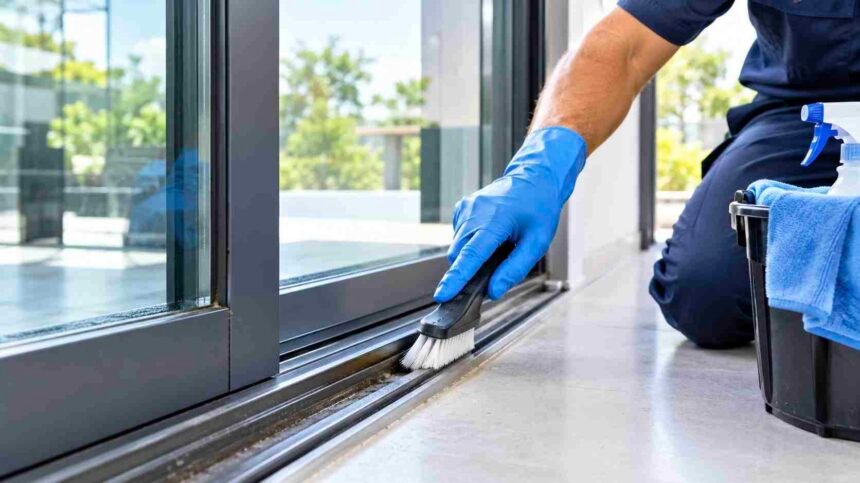
Anyone can see when a window is dirty. Streaks on the glass show up the moment the sun hits them, which is why glass gets wiped constantly while the track underneath a sliding balcony door gets touched maybe twice a year, if that. The track is where the real mess actually lives.
Fine sand finds its way into every groove along a balcony door, then mixes with humidity and whatever rolled off the glass during the last clean. Over months that mixture hardens, and a door that used to glide starts dragging, catching, or refusing to close properly on a windy afternoon.
Why the Glass Is the Easy Part
Glass is flat, visible and forgiving. A few wipes with the right cloth and almost any smear disappears, which is probably why most households judge an entire clean by how the glass looks afterwards rather than anything happening around it.
Tracks, frames and seals do not offer that same instant feedback. Dirt accumulates quietly in a channel nobody is looking into on a normal day, and the only sign something is wrong is a door that suddenly feels heavier to slide than it used to.
By the time a sliding door audibly scrapes or sticks halfway, the buildup inside the track has usually been growing for a long stretch already. The sound is the final symptom, not the first one, and it arrives well after the actual problem started.
Treating glass and track as the same job, on the same schedule, misses how differently they get dirty. Glass responds to a quick pass. A track needs something closer to excavation on a bad year, especially after a dusty season.
What Collects Inside a Sliding Track
Airborne sand in Dubai is finer than beach sand and gets everywhere, including into a channel barely wide enough for a fingertip. It settles, gets slightly damp from condensation overnight, and compacts into something closer to a thin layer of grit than loose dust.
Insects add to it too, especially near balconies with plants or anything left out overnight. A dead insect or two seems trivial on its own, but over a season that debris mixes with grit and old lubricant residue into a paste nobody wants to touch with bare hands.
Rollers at the bottom of a sliding panel suffer the most from all this. Grit works its way into the wheel mechanism the same way it works into a bicycle chain left outside, and the door starts feeling noticeably heavier long before anyone thinks to look down at the actual track.
A vacuum with a narrow nozzle attachment handles the loose material reasonably well on its own. What it cannot shift is the compacted layer underneath, the part that actually needs scraping out gently before anything gets wiped or flushed through with water.
Frames, Seals and Insect Screens
Rubber seals around a frame hold up against the sun for years, then crack all at once rather than gradually, usually right when the dry season turns into the next round of heat. A seal that looks fine can already be letting dust through at every corner.
Insect screens on balcony doors trap a surprising amount of fine dust simply by doing their job, filtering air that would otherwise blow straight into the living room. Rinsing a screen in place often just pushes the same dust further into the mesh instead of removing it.
Frame corners collect their own quiet buildup, partly from the same airborne sand and partly from whatever runs down the glass during the rare proper rain Dubai gets. Corners dry slowly, which gives anything organic a better chance to take hold than it would on a flat surface.
None of this is dramatic work. It is patient, slightly tedious, and easy to skip precisely because none of it is visible from a normal standing position looking at a closed door from across the room.
Where a Reasonable Clean Stops
Not every window in a Dubai home is reachable the same way. Ground floor units, villas and anything accessible from a balcony or a window that opens inward are a different job entirely from upper floors of a tower with sealed glazing.
High-rise facade work sits in its own category, with its own equipment and its own risk, and it belongs to specialists set up for exactly that, not to a household cleaning visit that focuses on tracks, frames and screens from the inside.
A sensible booking makes that distinction clear from the start rather than finding out halfway through a visit. Most households booking window cleaning by EcoClean or a similar service simply want confirmation of what can be reached safely from inside the home or from a balcony, and nothing more ambitious than that.
That kind of limit is not a weakness in the service. It is the difference between a company that understands what it is actually qualified to do from a balcony or an open window and one that promises more than any reasonable team should attempt from that position.