

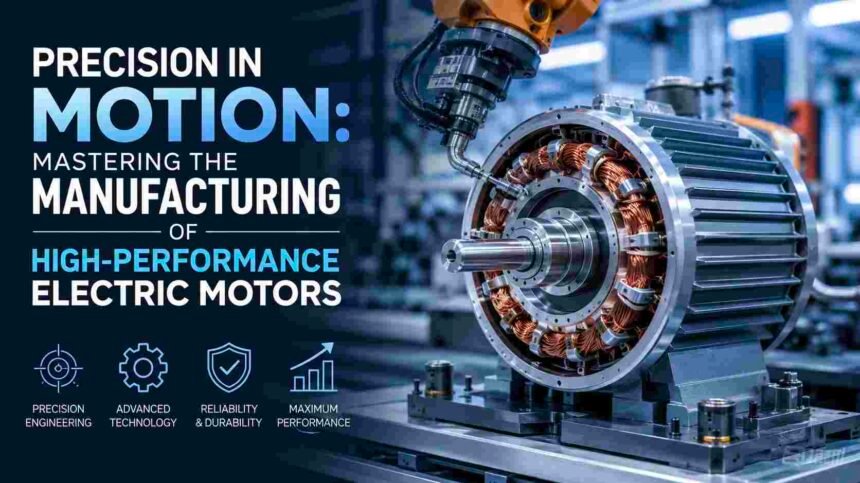
The evolution of modern industry relies heavily on the ability to move components with extreme accuracy and reliability. Electric motors serve as the heartbeat of this movement, powering everything from robotic arms on assembly lines to critical medical devices. Achieving high performance in these motors requires a rigorous approach to manufacturing, where every micron of tolerance and every choice of material impacts the final output.
The Engineering Foundation of Precision Motors
Manufacturing a high-performance motor begins long before assembly. It starts with a design philosophy that prioritizes thermal management, magnetic efficiency, and mechanical stability. Engineers must account for the interplay between electromagnetic forces and physical structural constraints. If a motor generates too much heat or exhibits excessive vibration, its precision will degrade rapidly under load.
Designers focus on optimizing the magnetic circuit to reduce losses while maximizing torque density. This optimization process involves selecting high-grade electrical steels and advanced winding patterns. By refining the interaction between the rotor and stator, manufacturers can create systems that deliver consistent power without sacrificing energy efficiency.
Manufacturing Challenges and Solutions
Creating a device that operates with high precision presents unique obstacles. The assembly process must be clean and highly controlled. Contamination of any kind can interfere with the tight air gaps required for high efficiency.
Achieving Micron-Level Tolerances
To ensure smooth operation, components such as shafts, bearings, and rotor assemblies must be machined to exceptionally tight tolerances. This level of precision minimizes internal friction and prevents unwanted radial play, which can lead to noise and vibration. One specific type that benefits from these refined manufacturing techniques is the permanent magnet DC motor, which relies on consistent magnetic field orientation for optimal performance. Manufacturers utilize advanced machining centers and automated inspection systems to verify that these parts meet exact specifications throughout the production run.
The Role of Precision Assembly
Assembly is often where the most significant gains in quality are made. Automated winding machines ensure that copper coils are packed with maximum density, which improves electrical characteristics. Robotic systems then handle the delicate insertion of rotors into stators, ensuring perfect alignment without causing physical damage to delicate surfaces. This level of automation reduces human error and provides repeatability that is simply not possible with manual methods.
Quality Control and Reliability
Reliability in the field is the ultimate test of a motor design. High-performance motors are often expected to run for thousands of hours without failure, sometimes in extreme environments.
Testing Protocols
Before leaving the factory, every motor undergoes a series of diagnostic tests. These tests include high-voltage insulation checks, torque consistency measurements, and dynamic balancing. Balancing is particularly critical, as even a small imbalance at high rotational speeds creates forces that lead to premature bearing wear. Modern balancing machines can detect and correct these imbalances with high speed and precision.
Thermal and Environmental Stress
Manufacturers also employ accelerated life testing to simulate real-world conditions. By exposing motors to thermal cycling, shock, and vibration, they can identify potential weak points in the design. These insights drive continuous improvement, leading to more robust seals, improved heat dissipation methods, and more durable structural materials.
Future Trends in Motor Production
The manufacturing landscape is shifting toward greater integration of data and intelligent systems. Industry standards are rising as customers demand more information about the performance and health of their equipment.
Smart Manufacturing
Factories are adopting sensor-based monitoring to track the health of the production equipment itself. By analyzing vibration and thermal signatures, facility managers can predict when a machine requires maintenance before it breaks down. This shift toward predictive maintenance ensures that the manufacturing process remains as consistent and reliable as the motors being built.
Advanced Materials
The use of new materials is also changing the industry. Lighter, stronger alloys allow for more compact designs without losing power density. Additionally, improved insulation materials withstand higher operating temperatures, enabling motors to be pushed harder without the risk of electrical shorting.
Conclusion
Manufacturing high-performance electric motors is a balancing act of physics, engineering, and meticulous process control. By prioritizing precision during every stage of production, from initial component machining to final assembly and testing, manufacturers can deliver motors that set the standard for speed, reliability, and efficiency. As technology advances, these processes will continue to evolve, enabling even greater levels of performance in the machines that power our world.